
Check articles for AI use before publishing in Kotia
Add the AI detector after your article is ready, save the report separately, review marked passages, and decide what to edit before publishing.
On this page4
Check finished articles for signs of AI use before you publish. In Kotia, after the material is ready, you can add an "AI detector" and save its analysis next to the text. You will see an overall score and marked passages to review when you read.
The result helps you organize review of your materials, but it does not prove who wrote the article. The detector also does not check facts or assess how useful the text is for readers. Make the publishing decision based on the material itself, its sources, and your project's requirements.
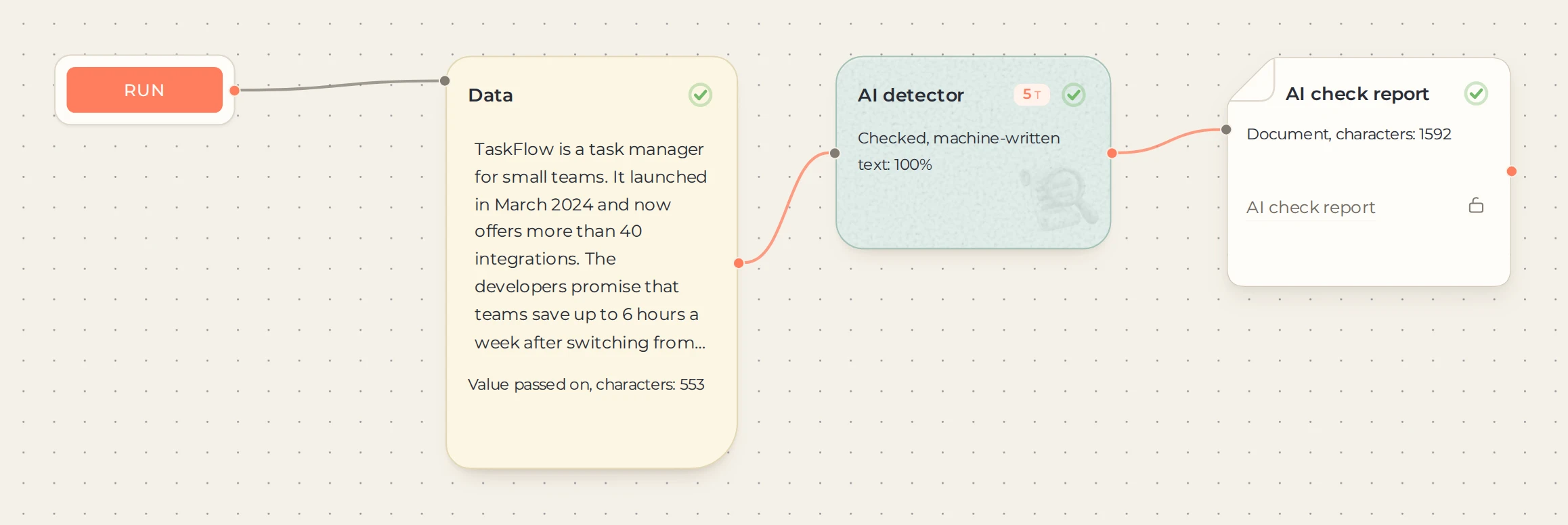
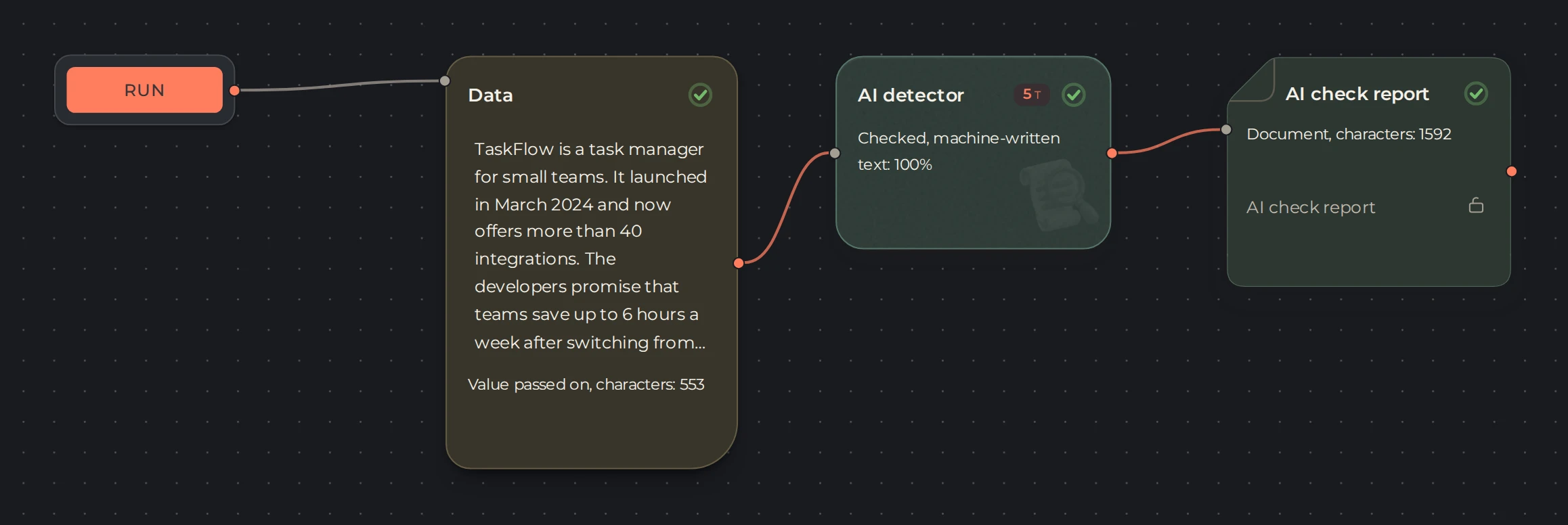 123
- 1The text to check
- 2Summary line: share of machine-written text
- 3A separate document for the report
Example: checking a blog article
Suppose you received a review from an author, or you prepared it with AI, and you want to do an editorial check. Save the original text, run the check, and read the marked places in context.
If the marked places include repeated introductory phrases, repeated conclusions, or vague promises, fix those specific problems: add concrete details, remove the repetition, or explain the benefit to the reader. The goal is to improve the material. Rewriting text until it reaches "the right percentage" does not prove authorship or quality.
How to get a separate report
Pass the finished text through "Data", a selected "Document", or the output of the writing step. The text you check must be between 500 and 50,000 characters.
Connect the "AI detector". It has no instructions field: you cannot choose a model in words or ask it to check only certain types of phrases. The detector checks the text you pass to it.
Connect the output of the detector to a separate "Document" for the report, or to a "Folder". Save the original separately so the check result does not replace the article.
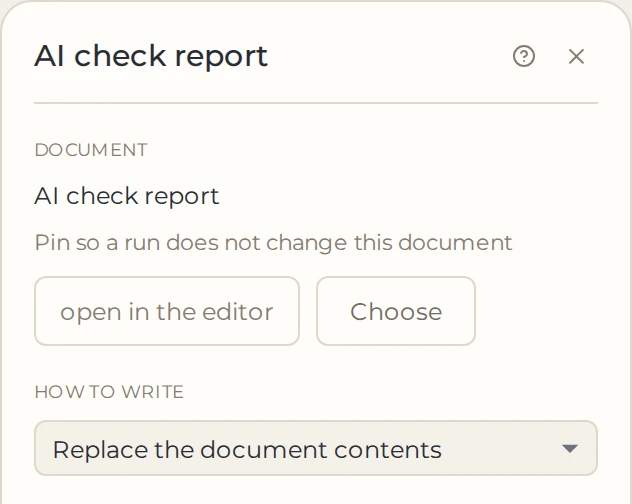
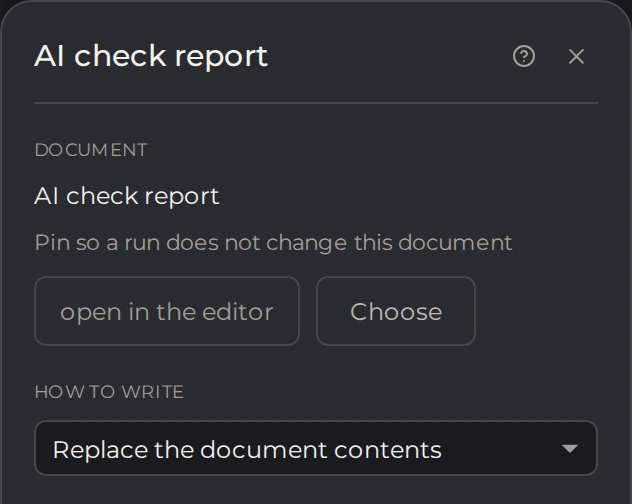 12
- 1A separate document for the report
- 2The article itself stays untouched
Run the chain. Tokens are charged based on the length of the text.
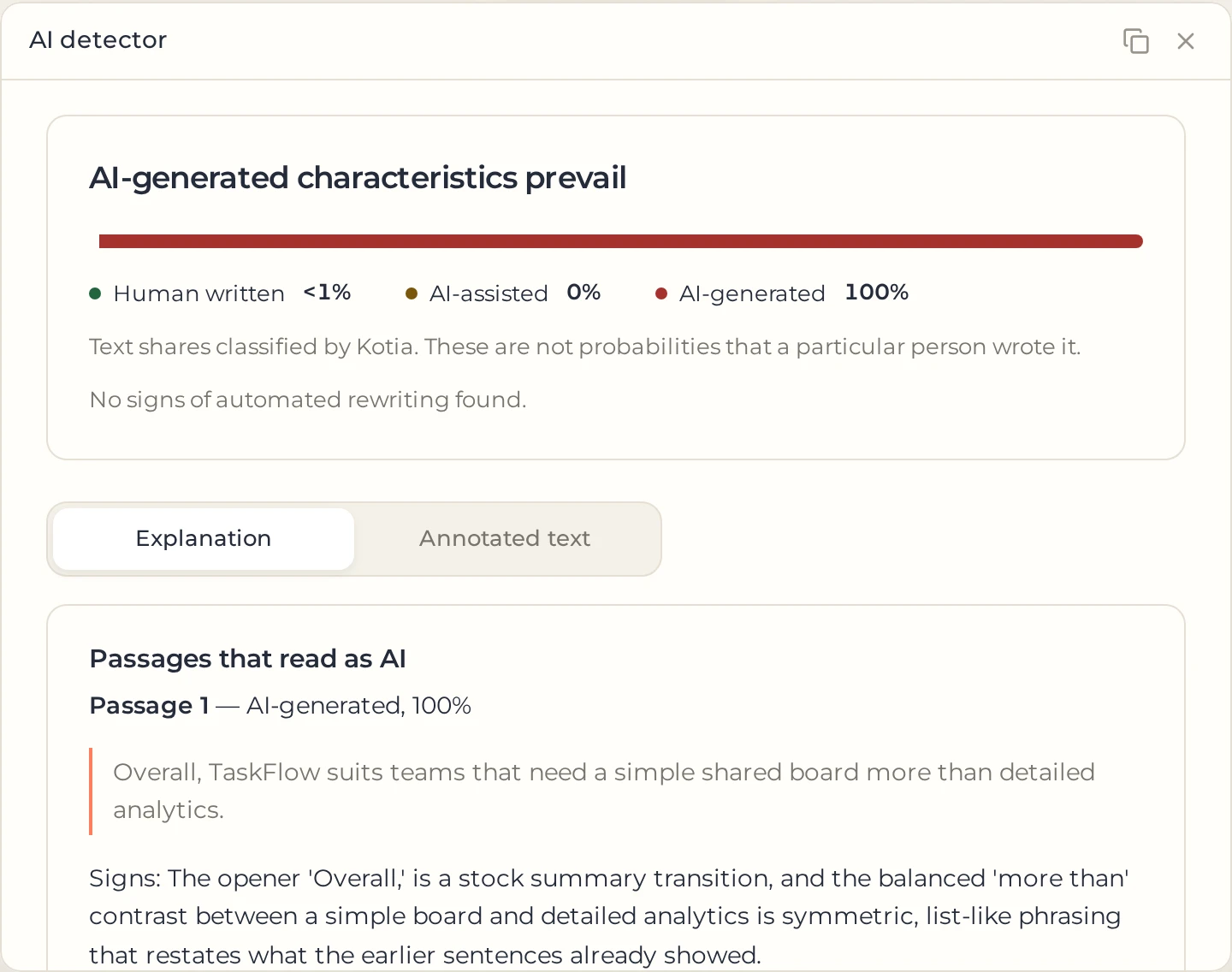
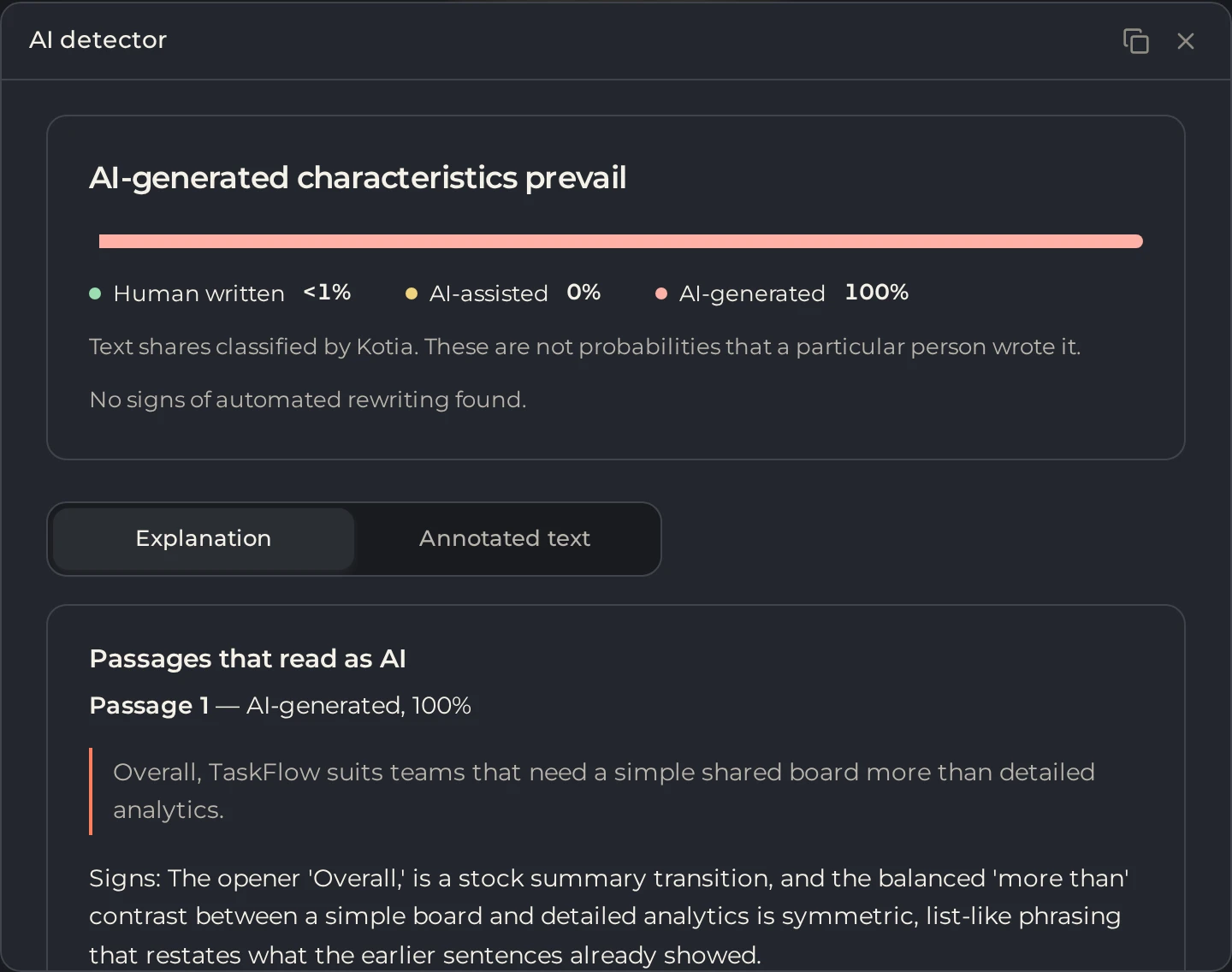
After the run, the detector card shows a summary line, such as "Checked, machine-written text: 100%". Open the result: at the top are the verdict and the text shares "Human written", "AI-assisted" and "AI-generated"; below are the "Explanation" and "Annotated text" tabs. Compare them with the original article.
 12
- 1The verdict of the check
- 2Shares: human written, AI-assisted, AI-generated
Edit the text on substance and complete any other checks you need before publishing.
If you need to assess only part of a long material, pass a separate complete passage of an allowed length. Do not combine unrelated texts into one result if you want to understand the score for each of them.
How to interpret the result
| Part of the result | How to work with it |
|---|---|
| Verdict and three shares | Use as the detector's score, not as proof of authorship. The shares classify the text; they are not the probability that a particular person wrote it |
| "Explanation": passages that read as AI | Reread each passage in context and decide whether there is a specific editorial problem; it also lists what to fix first |
| "Annotated text" | See which paragraphs the detector classed as AI-generated; the explanation is not proof either |
Even a low probability score for AI use does not confirm that the text is accurate. A wrong figure or a made-up reference can stay in material of any origin. To check such facts, use fact-checking.
How to add a check before publishing
The detector's output is a report, not the original article: the verdict, the shares, the explanation and a copy of the text with labels such as "[AI-generated]" go on through the connection. So if you want to publish the material, do not connect the detector directly to sending to Telegram or WordPress. Otherwise the report with labels will be published instead of the article.
The simplest approach is to save the article and the report separately, read them, and publish the chosen text after your edits. If you build a more complex chain, explicitly pass both materials to the next editorial step, and make sure the output is the article itself.
The text analysis may be worded differently in repeated checks. A repeated check after changes is charged again. Keep the report together with the version of the text that was checked: the result for an old draft does not automatically describe later edits.