
Market and competitor analysis with Kotia from public sources
Set the segment, geography, criteria and questions, then get a report comparing competitors from public sources, with links to check each conclusion.
On this page9
Ask Kotia to collect and compare public information about the market and competitors. Set the segment, geography and criteria, and the service will review sources and prepare a report based on your request. For example, it will compare product features, terms of use and differences in offers.
You can use the result when choosing a tool or when preparing your own service. In the task, it makes sense to ask for a comparison table and links so you can check the conclusions. A report based on public data does not replace your own sales data or research into customer demand.
Example: review of services for small editorial teams
You are researching the market for tools for editorial teams of 3–10 people. Ask Kotia to compare services for collaborative editing, comments, roles, version history, export and plan limits, and to find recurring complaints in reviews.
In the report, you can compare companies' offers and highlight questions for further review. For example, how editorial teams handle edits and what they lack in existing tools. Below is the task for this kind of research and the steps to start it.
Which products and terms to compare
Start with the decision the report should support. Instead of "research the services market," write: "find out which tasks of small editorial teams existing services already cover and which problems remain." Then it is clear what to include in the research and what to leave out.
Specify the comparison conditions in the task:
| What to define | Example for our task |
|---|---|
| Decision | Choose one collaboration problem of an editorial team to test further in interviews. |
| User | Editorial teams of 3–10 people who prepare and review texts together. |
| Segment | Services for collaborative editing and preparing publications; treat general office suites as an alternative. |
| Geography and language | International services with German-language public documentation; report in English. |
| Period | Current terms as of the research date; reviews from the last 12 months. Mark older information. |
| Criteria | Editing, comments, passing text between participants, roles, version history, export, plan limits. |
| Sources | Official pages on features and terms; independent reviews to describe user experience. |
Boundaries matter more than the length of the competitor list. A narrow segment of a few comparable solutions will be more useful than dozens of random tools. It is better to list direct competitors and alternative ways to solve the task separately. For example, an office suite may cover part of the need, but it is not a specialized editorial service.
How to write a task for competitor analysis
Include the context, comparison rules and result format in one request. Below is an example you can adapt:
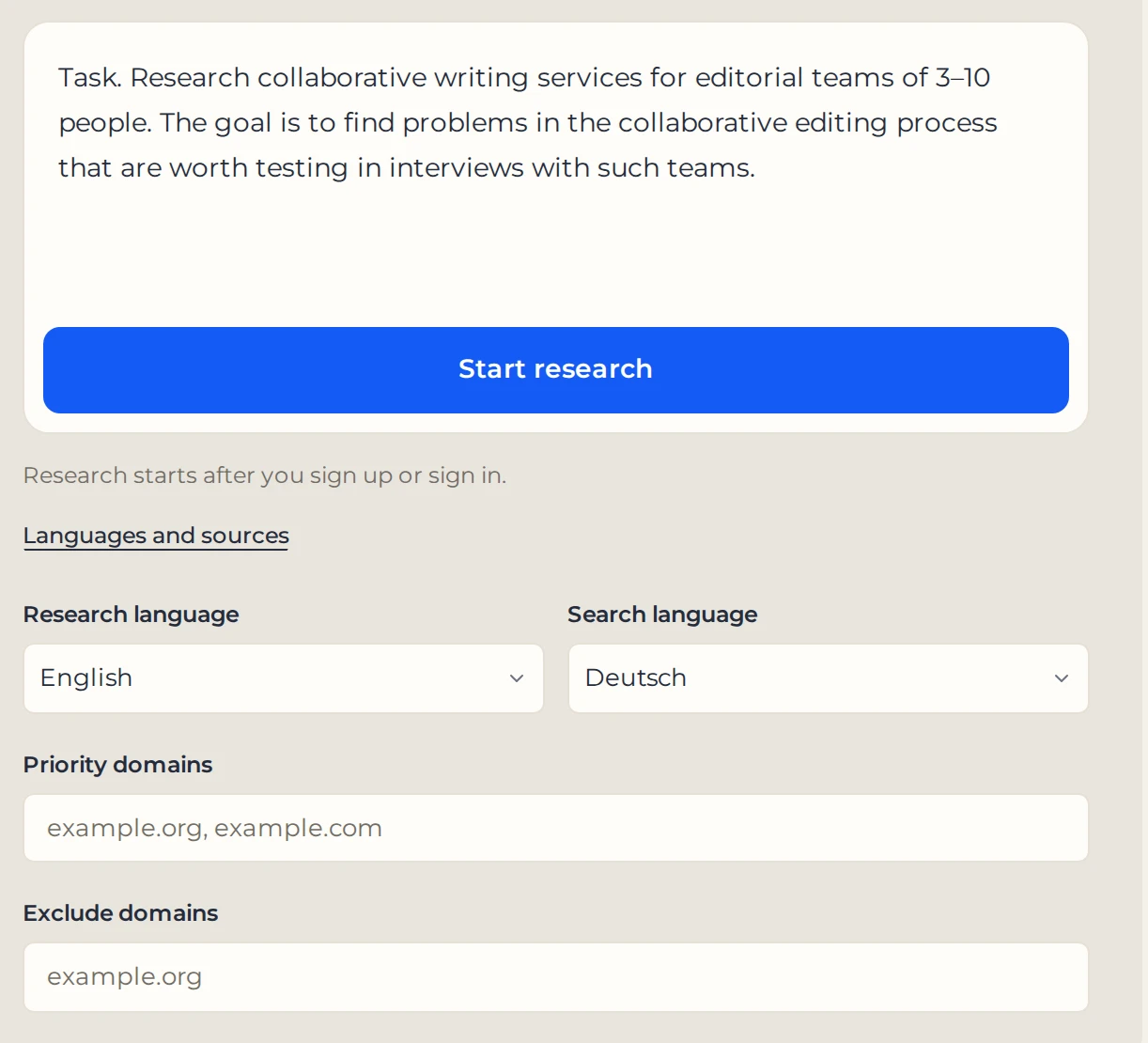
Task. Research collaborative writing services for editorial teams of 3–10 people. The goal is to find problems in the collaborative editing process that are worth testing in interviews with such teams.
What to compare. Consider international services with public documentation in German. Identify direct solutions for editorial work and, separately, general-purpose alternatives. Compare no more than six of the most suitable options and explain why each is included.
Period and sources. Use the terms in effect on the research date. For user experience, look for reviews from the last 12 months; mark older observations. Do not mix official specifications with user opinions.
Result format. Prepare: short conclusions; a table covering collaborative editing, comments, working on edits, roles, version history, export and plan limits; recurring problems from reviews; a list of hypotheses for interviews.
Verification. For significant facts, provide a link and a date. If there is no data, write "Not found", not "there is no such feature". Do not estimate market size or company shares without a source and an explanation of the method. At the end, list the gaps and contradictions that prevent a confident conclusion.
The limit of six options sets the right scope for the result, but it does not guarantee that the service will find exactly that many companies. If information is scarce, an incomplete table with honest notes is more useful than one filled with guesses.
Do not state the conclusion you want in advance, for example: "show that there are no convenient solutions on the market." Ask for evidence supporting the hypothesis and for objections to it.
How to choose sources and start the research
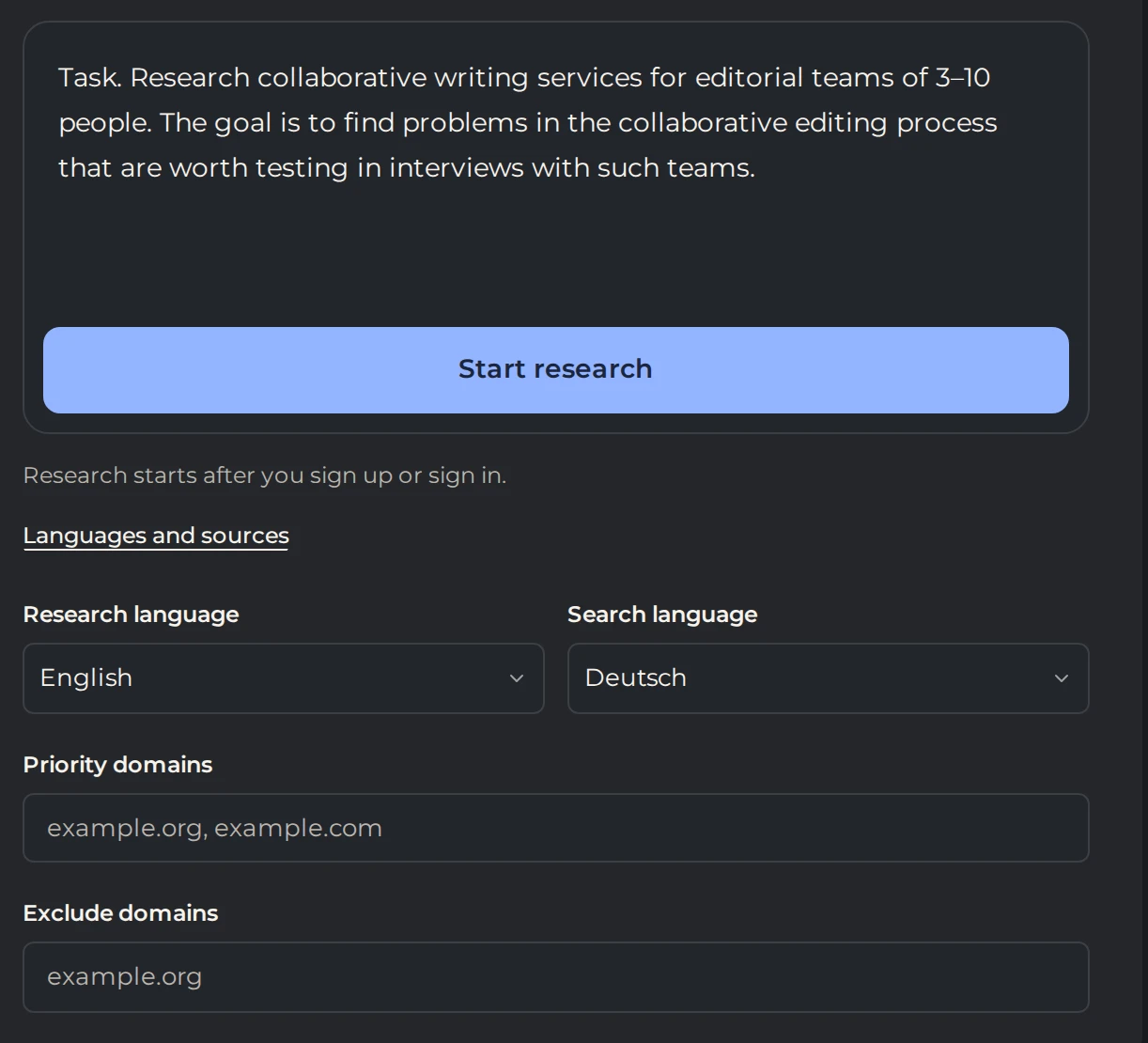
Open the research page, paste your prepared question and expand "Languages and sources".
 123
- 1Your question
- 2Languages and priority or excluded sites
- 3Start research
For our example, choose:
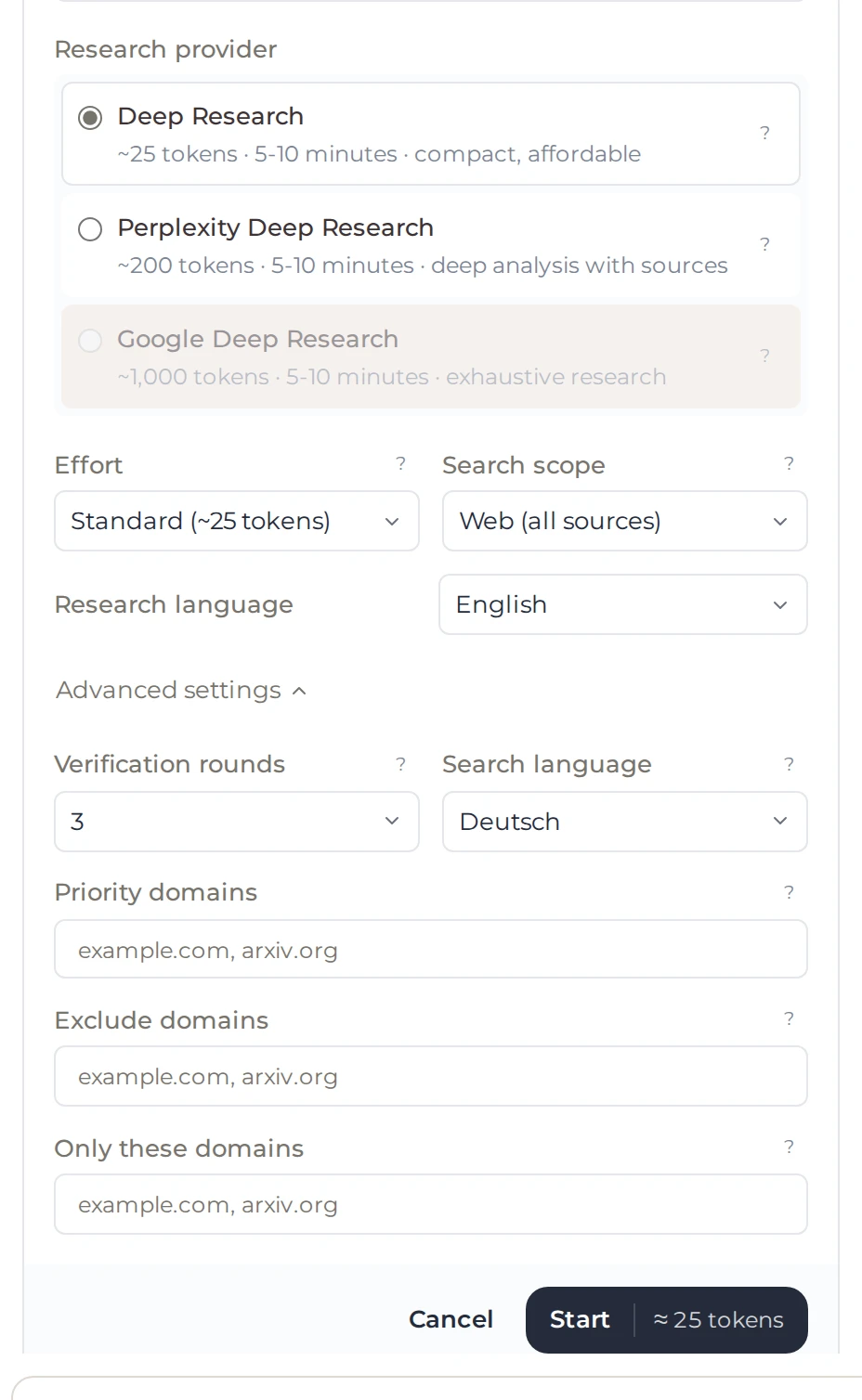
- Research language — English: the final report will be written in English.
- Search language — German: the selected documentation and a significant share of the reviews you need are published in it.
- Priority domains — as needed: add known official websites if you want to use them as the basis for comparison.
- How to write domains: the site name only, without
https://or a path, for exampleexample.com; separate several with commas. - Exclude domains — only with a clear reason: for example, if a certain platform is not relevant to the task. For analysis of user experience, keep the option to search for independent reviews.
Prioritizing company websites does not prevent searching for independent materials. But if you limit the research to only their domains, the section on user problems may lack sufficient grounds. The "Only these domains" setting is available in the workflow. Use it to review specific websites, not for general market research.
A guest clicks the "Start research" button, after which they need to sign in or register. A signed-in user clicks "Continue in chat": the question moves to the chat, where you start the research. In the conversation, check the final brief, including both languages and source restrictions. If needed, supplement them before starting. After the run is complete, open the report itself and its sources.
 123
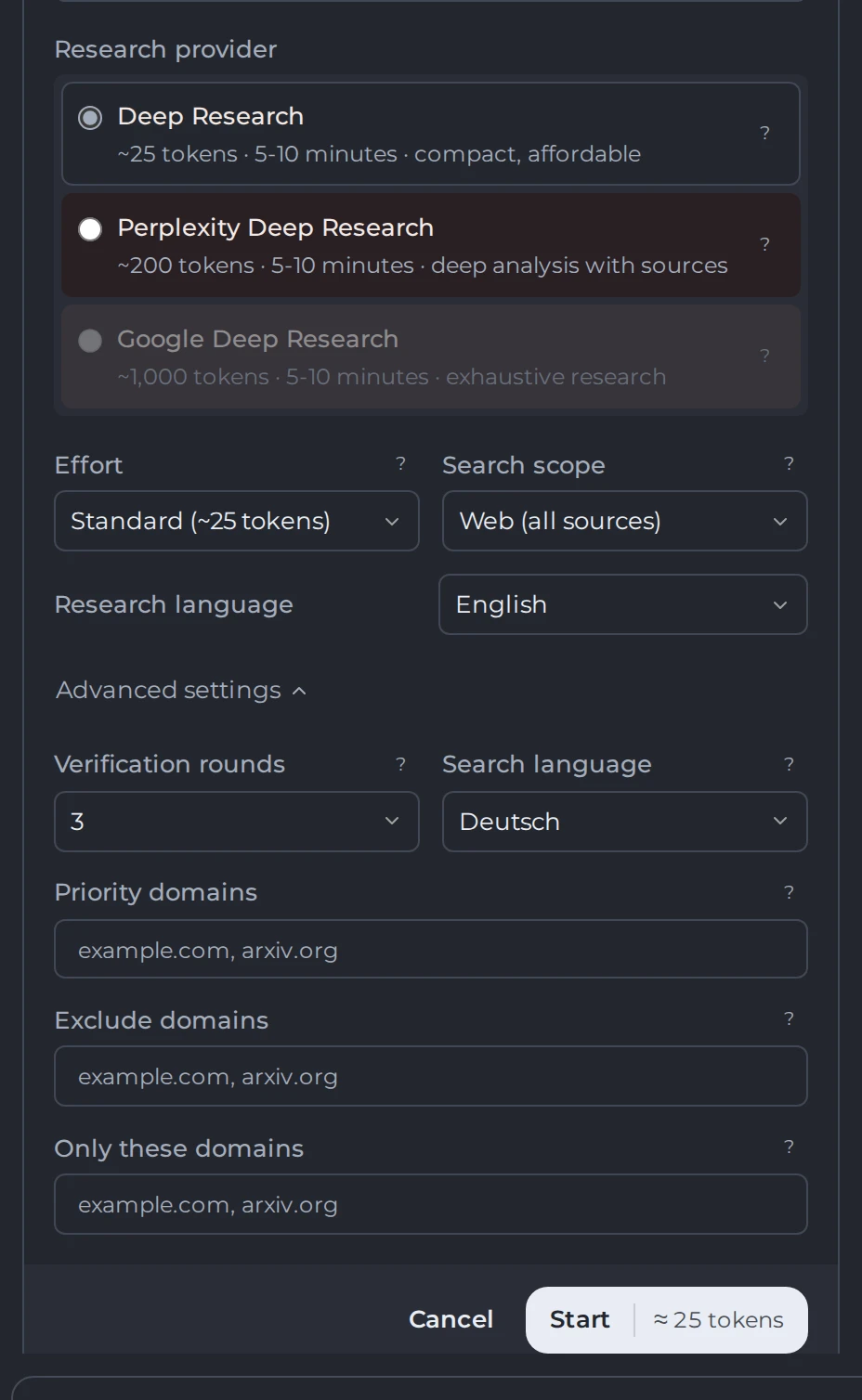
- 1Research language
- 2Search language
- 3Start and estimate
A standard research run costs 25 tokens. In the workflow builder, you can choose a different effort level: enhanced costs 50 tokens, and maximum costs 75 tokens. This is the cost of the service itself. The assistant's work and other steps are paid for separately. Running the research again is a new charge. For details on settings and payment, see the "Research" reference.
How to check the comparison against sources
Start not by judging how convincing the text sounds, but by checking whether the data is comparable: the table rows should answer the same question for each competitor.
| What to check | What the error looks like | How to fix it |
|---|---|---|
| Same scenario | One service was assessed for a single author, another for an editorial team. | Compare terms for one team size and one process. |
| Same units | A per-user limit is compared with a limit for the whole workspace. | Label the units and recalculate the terms for the team you need, if the source data allows it. |
| Same period | A current feature is compared with a review from two years ago. | Check the current documentation; keep an older observation with its date. |
| Feature and plan | The feature exists in the product but is available only on another plan. | Separate whether the feature exists from the terms of access. |
| Missing data | "Not found" has turned into "no". | Restore the note about uncertainty and add a question for manual checking. |
| Independent evidence | Several articles retell the same press release. | Find the original source; do not count retellings as independent confirmation. |
Open the original sources for facts that affect the choice, and check whether the page confirms the exact conclusion stated in the report. A link to a service's home page does not necessarily confirm a limit on a specific feature.
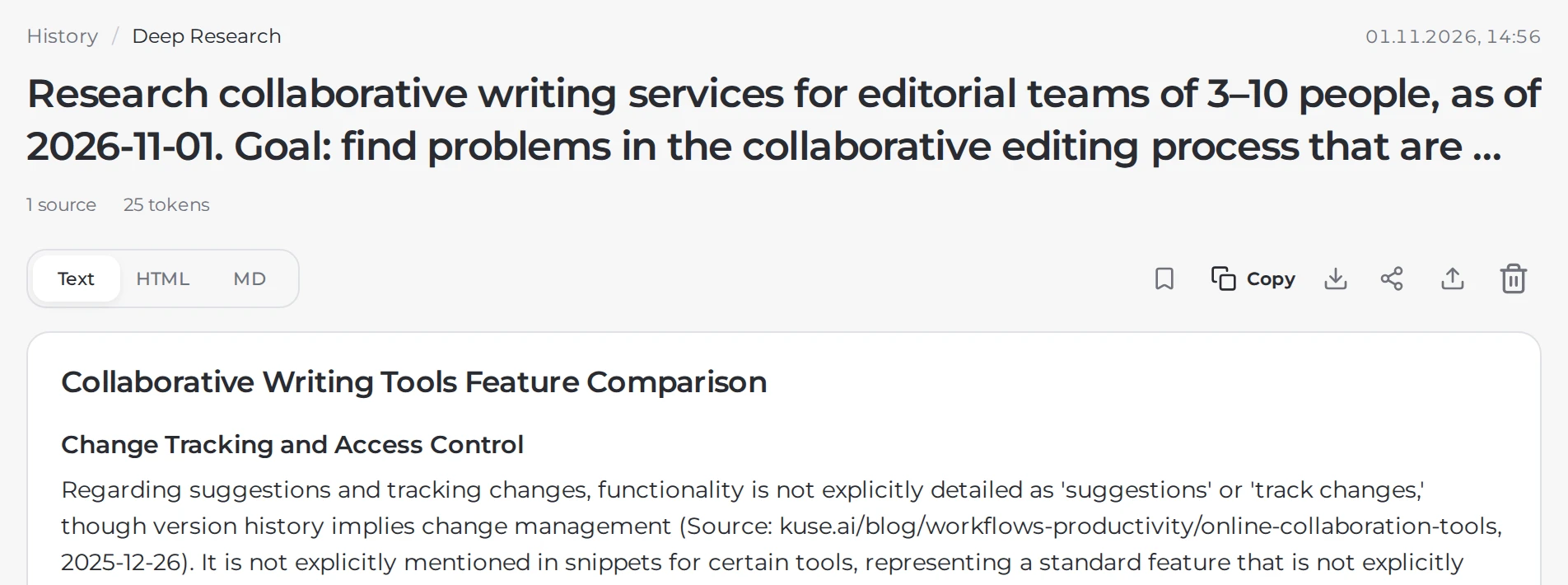
 12
- 1Number of sources
- 2Source and date next to the fact
Use reviews as material for hypotheses. Several complaints can suggest a question for an interview, but on their own they do not show what share of all users has run into the problem. Take into account the product version, the date, the team context and possible audience bias on the platform.
You can go to the sources from the research page. If the report is open in the "Document" in a workflow, open the research material to navigate citations: the markers in the document text do not provide the same interactive navigation.
How to use the conclusions for your task
Put the verified results into a short memo. Separate observation from interpretation and the next step:
| Part of the memo | What it should contain |
|---|---|
| Observation | What was actually found: a feature, a limit, a recurring theme in reviews. Next to it, the source and date. |
| Possible explanation | What this may mean for the chosen segment. Clearly mark it as interpretation. |
| Unknowns | Which information is missing or contradicts other information. |
| Next check | A specific question for an interview, a trial use, or collecting your own data. |
For example, the limits of collaborative editing you find may be a reason to study how editorial teams pass text between the author and the managing editor. On their own, they do not yet prove that the market is ready to buy a new service.
Download the report as DOCX if you will edit it with colleagues, or as Markdown if you move the material to a knowledge base that supports it. HTML and TXT are also available. Save the research date together with the conclusions: product terms and the list of competitors change.
If the report is missing an important section, first identify the gap. For a new research run, formulate a narrow question, for example only about working with edits and roles, and include the necessary context in the task. Do not run the same broad request in the hope that the new result will be better.
How to adapt the workflow to another task
Local market
Set a specific geography and search in the language of the region. Clarify whether to include companies without a local presence, as well as offers unavailable to the chosen audience. Do not automatically apply an international review to local demand.
Comparing offers for purchase
Replace the interview hypotheses with mandatory requirements: team size, use cases, access restrictions, data migration. Ask to separate confirmed terms from questions to clarify with the vendor. Before making a decision, check the currency of key terms yourself.
Studying reviews
Narrow the task to user experience: where difficulties arise, in what context, and how people work around them. Ask to show examples and opposing observations. How often a problem is mentioned in the set you found does not equal its share across the whole market.
Repeat snapshot after some time
Keep the original brief and criteria, and specify the new period in the new task. Compare identical attributes and note whether the product itself has changed or only the data source. A new run creates a new research report, so the comparison with the previous report must be stated explicitly in the task.
What most often spoils market research
- Topic that is too broad. "Everything about the content market" does not set criteria for completeness. Start with one segment and one decision.
- The conclusion is set in advance. Asking to confirm an idea gets in the way of seeing objections. Add a question about which facts contradict it.
- Only official websites. They suit features and terms, but are not enough for conclusions about user experience.
- Third-party estimates without methodology. Estimates of market size, growth rates and shares cannot be compared without checking definitions, period and geography.
- A table without unknowns. An empty cell should not be filled with a guess. A separate list of questions makes further work more precise.
Further reading
- Research settings and cost — managing sources, languages, effort level and output.
- What Deep Research means — how deep search works and its limits.
- Source collection — if you first need a set of materials to read on your own.